
Receptacle Layout: CEC Requirements & Design Tips

Receptacle layout may seem straightforward, but it's one of the most frequent sources of ESA inspection deficiencies. The CEC has specific, measurable rules - and most failures happen because the designer didn't know the edge cases.
CEC Rule 26-722: The Spacing Rule
The foundational rule for residential receptacle placement. CEC Rule 26-722 Item (a) requires duplex receptacles in the finished walls of every room or area - except bathrooms, hallways, laundry rooms, water closet rooms, utility rooms, and closets (which have their own separate rules).
No point along the floor line of any usable wall space in a dwelling unit is allowed to be more than 1.8 m horizontally from a receptacle in that space or in an adjoining/adjacent space. The measurement is taken along the floor line of the wall spaces.
Practical Layout Method (CEC Handbook 2024)
The 1.8m rule translates to a maximum 3.6m spacing between receptacles. Here's the step-by-step method:
| Step | Action | Max Distance |
|---|---|---|
| Step 1 | Start at the beginning of the usable wall space | 0 m |
| Step 2 | Place first receptacle within 1.8m from the start of the wall | 1.8 m |
| Step 3 | Place next receptacle within 3.6m from the previous one | 3.6 m |
| Step 4 | Repeat Step 3 along the wall until the end is reached | 3.6 m each |
| Step 5 | Last receptacle must be within 1.8m of the end of the wall | 1.8 m |
Why 3.6m between receptacles? Because the midpoint between two receptacles spaced 3.6m apart is exactly 1.8m from the nearest one - satisfying the "no point more than 1.8m" rule. The 1.8m at the start and end ensures coverage at the wall edges.
Balcony & Porch Requirement
CEC Rule 26-722 Item (b): At least one duplex receptacle must be provided in each balcony or porch that is not classified as a finished room or area.
Receptacle spacing in a dwelling room
A typical living room, not a specific project. Measurements are taken along the floor line.
Parts
1.8 m rule. No point along the floor line of a usable wall space may be more than 1.8 m from a receptacle. Place the first one within 1.8 m of where the wall space starts. Rule 26-722 a)
3.6 m maximum spacing. Two receptacles 3.6 m apart leave the midpoint exactly 1.8 m from each. The last one sits within 1.8 m of the end of the wall space.
Doorways and the wall behind a fully open door are not usable wall space. Item c)
Sliding glass doors and windows to the floor are not usable wall space.
Fireplaces and similar permanent installations are not usable wall space.
Walls narrower than 900 mm are not usable wall space and need no receptacle.
- Duplex receptacle
- 1.8 m reach along the floor line
- Not usable wall space
What Counts as "Usable Wall Space"? (Item c)
This is where most misunderstandings occur. Per the CEC Handbook 2024:
- Any finished wall space 900 mm or wider (measured along the floor line)
Not considered usable wall space:
- Wall spaces less than 900 mm in width (measured along floor line)
- Doorways, and the area behind the door when fully open
- Windows extending to the floor
- Fireplaces and any similar permanent installations
- Sliding glass doors (floor-to-ceiling type)
Hallway Rule
No point in a hallway within a dwelling unit is permitted to be more than 4.5 m from a duplex receptacle. The measurement is taken by the shortest path a supply cord would follow without passing through an opening fitted with a door.
Kitchen Receptacle Rules (Rule 26-722 Item d)
Kitchens have the most complex receptacle requirements in the CEC. The Handbook 2024 outlines these specific requirements:
Kitchen Requirements Summary
| Requirement | Detail |
|---|---|
| Refrigerator | One dedicated receptacle for each refrigerator in the kitchen (accessory fridges elsewhere don't fall under this rule) |
| Gas range | One receptacle behind the intended gas range location, mounted not more than 130 mm from the floor, as close as possible to the midpoint of the wall space |
| Counter spacing | No point along the wall line of counter work surfaces more than 900 mm from a receptacle (15A split or 5-20R T-slot) |
| Counter exclusions | "Counter work surfaces" excludes sinks, built-in equipment, and isolated work surfaces less than 300 mm long at the wall line |
| Island counter | Permanently fixed island with continuous long dimension ≥ 600 mm and short dimension ≥ 300 mm requires at least one 15A split or 5-20R receptacle |
| Remaining walls | Sufficient duplex receptacles on remaining finished walls per the standard 1.8m rule (Item a) |
| Dedicated circuits | At least 2 counter branch circuits, max. 2 receptacles each (Rule 26-654) |
Kitchen Counter Layout Method (CEC Handbook 2024)
The CEC Handbook provides a precise 5-step method for determining counter receptacle placement:
| Step | Action | Key Dimension |
|---|---|---|
| Step 1 | Determine unusable wall space along the counter wall line. Receptacles cannot be located directly in front of or behind the kitchen sink - except where the distance between wall and inside edge of sink exceeds 450 mm (e.g., corner sinks) | 450 mm (corner sinks) |
| Step 2 | Measure the first 900 mm from the beginning of the counter work surface. Place the first receptacle anywhere within this distance | Max 900 mm |
| Step 3 | From the first receptacle, measure 1800 mm along the counter at the wall line. Place the next receptacle within this distance | Max 1800 mm |
| Step 4 | Repeat Step 3 until the end of the counter is reached (most kitchens don't have uninterrupted counter space > 3.6m, so this step is rarely needed) | Max 1800 mm each |
| Step 5 | Verify that the last receptacle is within 900 mm of the end of the counter | Max 900 mm |
Kitchen counter receptacles: what the Code asks for
A typical kitchen wall in a dwelling unit, not a specific project. Receptacles are drawn larger than scale.
Detail A: behind the gas range
Section at the wall, not to scale
Parts
Counter spacing. No point along the wall line of a counter work surface more than 900 mm from a receptacle: within 900 mm of each end, 1800 mm or less between. Rule 26-722 d)
Sink. The wall behind the sink is not counter work surface. No receptacle directly behind it unless the wall-to-sink edge exceeds 450 mm.
GFCI. Receptacles within 1.5 m of the sink are GFCI protected. OESC Rule 26-704
Gas range. One receptacle behind the range, no more than 130 mm above the floor, near the middle of the wall space. Detail A
Refrigerator. One dedicated receptacle behind each refrigerator.
Short pieces. Isolated counter pieces shorter than 300 mm at the wall line are not counted.
Counter circuits. At least two branch circuits, no more than two receptacles on each; 15 A split or 5-20R T-slot. Rule 26-654
All receptacles in a dwelling unit are tamper-resistant. Rule 26-706
- Counter receptacle
- Hidden behind an appliance
- GFCI receptacle
- Counter circuit
- Counter wall line, counted
- Not counted
- Within 1.5 m of the sink
- Dimensions in mm unless shown
The Split Receptacle Question
Kitchen counter receptacles can be 15A split-wired or 5-20R T-slot configuration. Split receptacles require a handle-tie or 2-pole breaker so both conductors disconnect together. Modern practice increasingly favors dedicated 20A T-slot circuits, especially where GFCI protection is needed near the sink.
GFCI Requirements
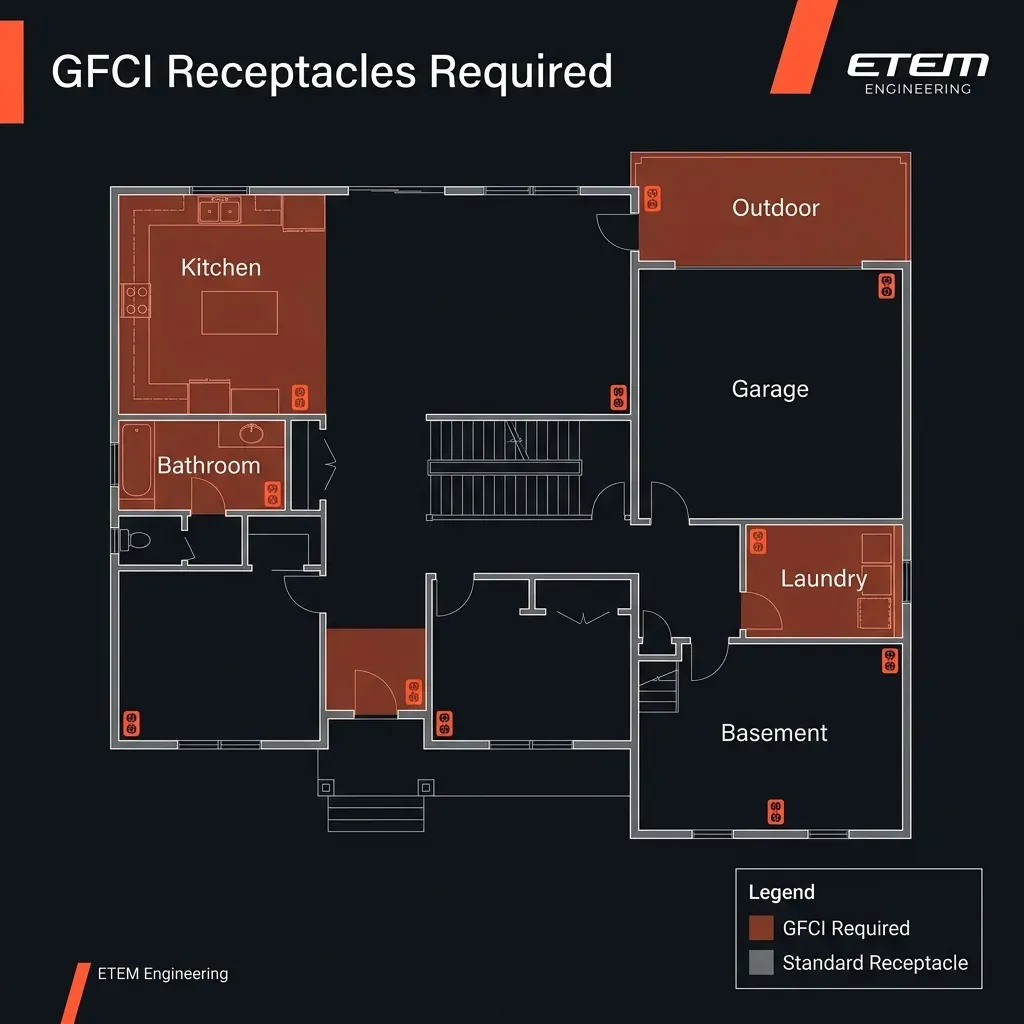
Ground Fault Circuit Interrupter protection is mandatory in locations where water and electricity coexist. Per OESC Rule 26-704 (Rule 68-068 for pools):
Our GFCI requirements guide covers each of these locations in detail, including kitchen counters, vehicle heater receptacles, pools and construction sites.
| Location | GFCI Required? | Notes |
|---|---|---|
| Kitchen counter | Yes | All receptacles within 1.5m of sink (cannot be directly in front of or behind sink unless wall-to-sink edge > 450mm) |
| Bathroom | Yes | Within 1.5 m of basin, tub or shower |
| Washroom (commercial) | Yes | Within 1.5 m of a sink |
| Outdoor | Yes | Within 2.5 m of finished grade |
| Garage | No | Unless within 1.5 m of a sink; carports count as outdoor |
| Unfinished basement | Only near sinks | Within 1.5 m of a sink or laundry tub |
| Pool/hot tub area | Yes | All receptacles within 3m |
| Laundry | Yes | Within 1.5m of sink |
| Sump pump | No | No dedicated circuit required by the OESC |
Wire Sizing: 14 AWG vs. 12 AWG
A common design question - when to use #14 vs. #12 copper:
| Wire Size | Max Breaker | Ampacity (90°C) | Typical Use |
|---|---|---|---|
| #14 AWG | 15A | 25A | General lighting, bedroom receptacles |
| #12 AWG | 20A | 30A | Kitchen small appliance, bathroom, garage, outdoor |
| #10 AWG | 30A | 40A | Dryer, A/C disconnect, EV charger (Level 2 small) |
| #8 AWG | 40A | 55A | Range/oven, larger EV charger |
| #6 AWG | 60A | 75A | Sub-panel feeder, large EV charger |
Ontario-Specific: The OESC adopts the CE Code (CSA C22.1:24) with Ontario amendments, so always verify with the current edition. Some amendments affect dwelling units, such as the electric range receptacle required by Rule 26-744 4).
Top 5 ESA Inspection Failures
Based on common field experience in Ontario:
- 1. Missing GFCI in bathroom or kitchen - a common deficiency
- 2. Counter spacing violation - island or peninsula missing a receptacle
- 3. Outdoor receptacles without weather cover - requires "in-use" cover (not just flip-up) per Rule 26-708
- 4. Garage receptacle on wrong circuit - must be on the separate garage/carport branch circuit the Code requires
- 5. Missing tamper-resistant receptacles - required in all dwelling units per CEC Rule 26-706
Commercial vs. Residential Differences
The 1.8m rule (Rule 26-722) applies to dwelling units only. Commercial spaces have different requirements:
- Receptacle count is typically driven by furniture layout and load requirements
- Open-plan offices: typically 1 duplex per workstation
- Conference rooms: floor boxes + wall receptacles for AV
- Dedicated circuits for copiers, printers, and server equipment
- GFCI still required within 1.5 m of sinks and for outdoor receptacles
Frequently Asked Questions
What is the CEC 1.8m receptacle spacing rule?
CEC Rule 26-722 requires that no point along the floor line of any usable wall space in a dwelling unit be more than 1.8m from a receptacle. This means receptacles are spaced a maximum of 3.6m apart.
Where is GFCI protection required in Ontario?
GFCI is required for receptacles within 1.5m of sinks, bathtubs and showers (kitchens, bathrooms, laundry rooms), outdoors within 2.5m of grade (Rule 26-704) and near pools and hot tubs (Rule 68-068).
What is the minimum wall width for a receptacle?
A wall space must be at least 900mm wide (measured along the floor line) to be considered usable wall space requiring a receptacle per CEC Rule 26-722.
How far apart should kitchen counter receptacles be?
No point along kitchen counter work surfaces can be more than 900mm from a receptacle. After the first one, subsequent receptacles must be within 1800mm of each other. See our plug types guide for CSA (NEMA-style) receptacle configurations.


