Electrical Panel Upgrade in Ontario: The Complete 100A to 200A Guide
Your 100A panel was installed when the biggest electrical load in the house was a toaster. Today you need EV chargers, heat pumps, and home offices — and the math doesn’t work anymore. Here’s what a proper upgrade actually involves.
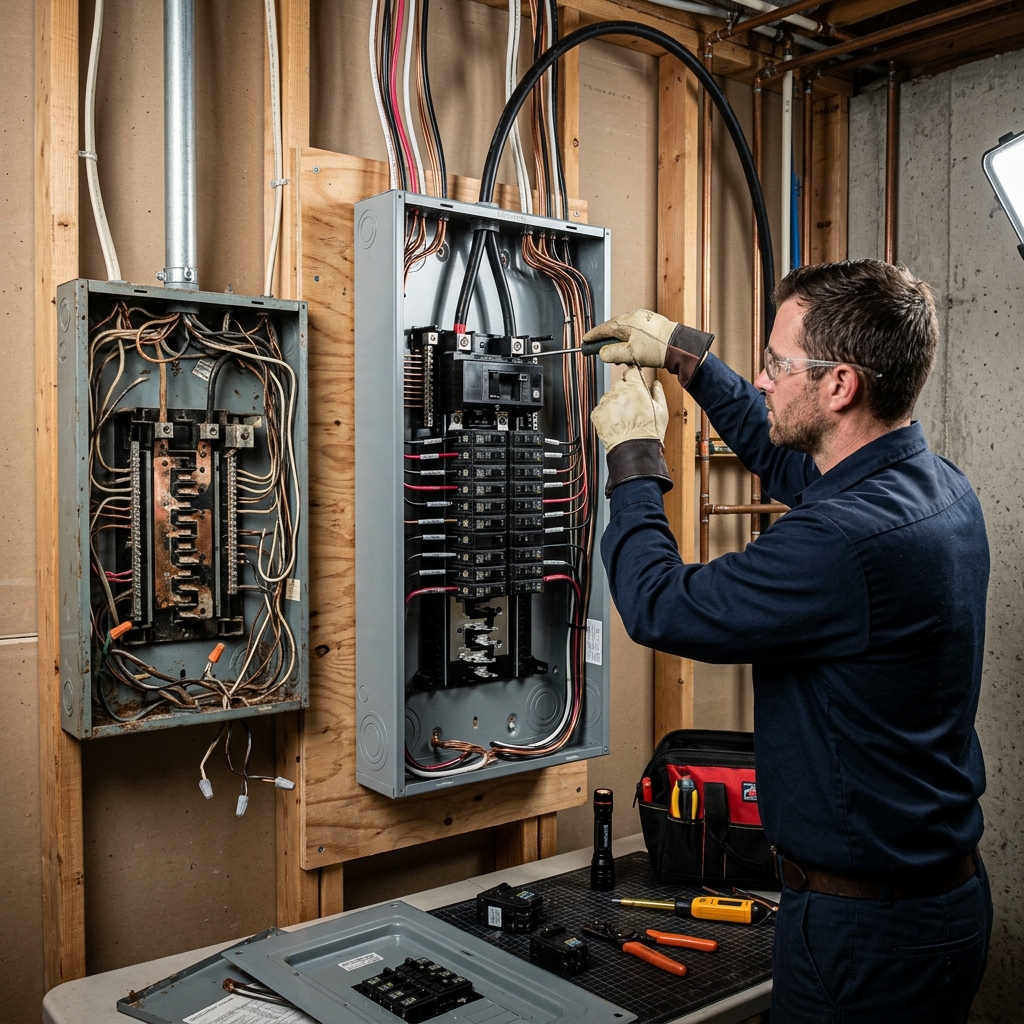
Why Upgrade from 100A to 200A?
Ontario homes built before 1980 typically have 100A service — sometimes even 60A. This was adequate for the era, but modern electrical demands have fundamentally changed:
| Load | Typical Draw | Impact on 100A Panel |
|---|---|---|
| Level 2 EV Charger | 30–50A (240V) | Uses 30–50% of total capacity |
| Electric Range/Oven | 40–50A | Uses 40–50% of total capacity |
| Central A/C | 20–30A | Uses 20–30% of total capacity |
| Heat Pump | 30–60A | Uses 30–60% of total capacity |
| Electric Dryer | 30A | Uses 30% of total capacity |
| Hot Tub / Sauna | 40–50A | Uses 40–50% of total capacity |
The math is simple: A typical Level 2 EV charger (32–40A) + central A/C (25A) + electric range (40A) = 97–105A demand on a 100A service. That’s before you turn on a single light.
7 Signs You Need a Panel Upgrade
- Breakers trip frequently — especially when multiple appliances run simultaneously
- Fuse panel (not breakers) — Federal Pacific, Zinsco, or screw-in fuse panels are safety hazards
- Adding EV charging — Level 2 chargers typically require 30–50A dedicated circuits at 240V
- Renovation or addition — basement apartments, additions, or kitchen remodels
- Double-tapped breakers — two wires on a single breaker = code violation
- Insurance requirement — many insurers won’t cover homes with 60A/100A fuse panels
- Real estate transaction — home inspection flagged the panel
CEC & OESC Requirements
A panel upgrade isn’t just swapping a box. The Canadian Electrical Code (CEC) and Ontario Electrical Safety Code (OESC) mandate specific requirements:
| Requirement | Reference | Details |
|---|---|---|
| Minimum service size | OBC O. Reg. 139/17 | 200A minimum for new homes with garage/carport/driveway (EV-ready provision) |
| Demand calculation | CEC Rule 8-200 | Residential load calculation: 5000W first + 25% remainder for general load |
| Service conductor | CEC Rule 4-006 | 3/0 AWG copper (90°C) for 200A |
| Grounding electrode | CEC Rule 10-102 | Grounding electrode system required; may include ground rod, water pipe bond, or Ufer ground |
| AFCI protection | CEC Rule 26-658 | Required on bedroom circuits; per ESA Bulletin 26-29-6, not retroactively required on existing circuits during panel swap if no new receptacles added |
| Panel clearance | CEC Rule 2-308 | 1m clearance in front of panelboard, 600mm minimum width |
For a detailed breakdown of demand calculations, see our Load Calculations & Transformer Sizing guide.
The Upgrade Process Step-by-Step
| Step | Who | Timeline |
|---|---|---|
| 1. Load assessment | LEC; P.Eng where required | Day 1 |
| 2. ESA permit application | Licensed Electrical Contractor (LEC) | Day 1–3 |
| 3. LDC notification | LEC coordinates with utility | Week 1–4 (Toronto Hydro: 10 business days initial review) |
| 4. Utility disconnect | LDC (Toronto Hydro, Hydro One, Alectra) | Scheduled day |
| 5. Service mast & weatherhead | LEC | Same day |
| 6. New panel installation | LEC | Same day |
| 7. Grounding electrode | LEC | Same day |
| 8. ESA inspection | ESA Inspector | 1–3 days after |
| 9. Utility reconnect | LDC | After ESA approval |
Important: The home is without power from Step 4 until Step 9 — typically 1–2 days. Plan accordingly. For utility coordination details, see our Toronto Hydro Connection Guide.
ESA Permits & Inspections
In Ontario, all electrical work requires an ESA notification (permit). This is not optional — it is provincial law under the Electricity Act.
- If hiring someone, they must be a Licensed Electrical Contractor (LEC)
- ESA inspection is mandatory before the utility will reconnect
- A Certificate of Acceptance is issued upon passing inspection
- Homeowners can do their own electrical work with an ESA notification, but panel upgrades involve live service conductors — strongly recommend hiring an LEC
For more on the permit process, see our Ontario Electrical Permit Guide.
What Affects the Cost?
Panel upgrade costs vary significantly based on several factors. Rather than quoting a specific number (which would be misleading), here are the variables that drive the price:
| Factor | Impact |
|---|---|
| Service mast replacement | Required if existing mast is undersized for 200A conductors |
| Meter base upgrade | 100A meter base must be replaced with 200A rated base |
| Underground vs. overhead | Underground service upgrades cost significantly more (trenching) |
| Grounding system | Older homes may need new ground rods and water pipe bonds |
| Number of circuits | More circuits to transfer = more labor |
| AFCI breaker requirements | AFCI may be required on new or modified bedroom circuits per OESC 29th Edition (CEC 2024); not retroactively required on existing circuits during a panel swap (ESA Bulletin 26-29-6) |
| Asbestos or vermiculite | Older homes may require hazmat assessment before work begins |
| LDC requirements | Some utilities charge reconnection or infrastructure fees |
Get accurate pricing: The only way to know the true cost is a site assessment by a Licensed Electrical Contractor. Request a free consultation from ETEM Engineering.
When Do You Need a P.Eng?
Not every panel upgrade requires a Professional Engineer. Here’s when you do:
| Scenario | P.Eng Typically Required? | Why |
|---|---|---|
| Simple 100A → 200A residential swap | No | LEC can typically complete load calculation, ESA notification, and installation |
| Service upgrade above 200A | Often / LDC-dependent | Larger services may require LDC load summary, drawings, or sealed letter; OESC plan review applies at ≥600A 1Φ or ≥400A 3Φ |
| Adding secondary suite / ADU | Depends | Building permit and municipality requirements vary; designer/BCIN or P.Eng may be required |
| Commercial panel upgrade | Likely yes / Depends | Minor work may only need LEC + ESA notification; larger services, permit drawings, or plan review may require P.Eng |
| Multi-unit residential | Often | Metering, demand calculations, service distribution, and permit submissions are commonly engineered |
For more details, read our P.Eng Stamp Requirements in Ontario article.
Frequently Asked Questions
How long does a panel upgrade take?
The physical installation takes about 1 day. However, LDC coordination (disconnect/reconnect scheduling) and ESA inspection add significant time. Toronto Hydro quotes 10 business days for initial review alone. Plan for 4–8 weeks total from application to energization, depending on your utility.
Can I upgrade from 100A to 400A?
Technically yes, but residential services above 200A are rare and require a P.Eng load calculation, a sealed load letter, and LDC approval. The utility may need to install a larger transformer.
Do I need a panel upgrade to install an EV charger?
Not always. A P.Eng or LEC can perform a load calculation to determine if your existing panel has capacity. Many 200A panels can accommodate an EV charger. Most 100A panels cannot. See our EV Charging Guide.
Is a panel upgrade covered by home insurance?
No — a panel upgrade is a home improvement, not an insurance claim. However, upgrading from a fuse panel or Federal Pacific panel may reduce your insurance premium or resolve coverage denials.
What is a Federal Pacific panel and why is it a concern?
Federal Pacific Electric (FPE) Stab-Lok panels were widely installed in Ontario homes from the 1950s–1980s. Independent testing has raised concerns about their breakers failing to trip under overload conditions. While no formal recall was issued, most electrical professionals and insurers recommend replacement due to the potential fire risk.
Get Your Panel Upgrade Checklist
ESA permit requirements, LDC coordination steps, CEC compliance checklist, and what to ask your electrical contractor.
Need a Panel Upgrade Assessment?
ETEM Engineering provides P.Eng load calculations, service upgrade engineering, and utility coordination for residential and commercial panel upgrades across Ontario.
Get a Free Consultation