Outdoor & Area Lighting Design: The Engineer's Guide to Parking Lots, Sports Fields, Streets & Parks
A poorly lit parking lot isn't just an inconvenience - it's a liability lawsuit waiting to happen. A sports field with hot spots and dark zones makes the game unplayable. A street lighting design that ignores uniformity creates dangerous driving conditions. Outdoor lighting is where engineering meets public safety, and getting it wrong has real consequences. Here's how to get it right.
The Foundation: IES Standards
All outdoor lighting design in North America is governed by the Illuminating Engineering Society (IES). The key standards are:
- IES RP-8 - Roadway and street lighting (luminance and illuminance methods)
- IES RP-20 - Parking facility lighting (open lots and garages)
- IES G-1 / RP-6 - Sports and recreational area lighting
- IES DG-4 - Pedestrian pathway and park lighting
Illuminance Requirements by Application
The following table summarizes target illuminance levels. These are maintained values - accounting for lamp depreciation and dirt accumulation over time:
| Application | Average Maintained (fc) | Average Maintained (lux) | Uniformity (Avg:Min) |
|---|---|---|---|
| Parking Lots (IES RP-20) | |||
| Basic (low activity) | 0.5 fc | 5 lux | 15:1 max |
| Enhanced security (high activity) | 2.5 fc | 25 lux | 4:1 recommended |
| Roadway (IES RP-8) | |||
| Local roads - low pedestrian | 0.4 fc | 4 lux | 6:1 |
| Collector roads - medium pedestrian | 0.8 fc | 8 lux | 4:1 |
| Major arterial - high pedestrian | 1.7 fc | 17 lux | 3:1 |
| Freeway | 0.6 fc | 6 lux | 3:1 |
| Sports Fields (IES G-1/RP-6) | |||
| Recreational / training | 20-30 fc | 200-300 lux | 2.5:1 |
| High school competitive | 30-50 fc | 300-500 lux | 2:1 |
| College / semi-pro | 50-75 fc | 500-750 lux | 1.7:1 |
| Professional / broadcast | 100+ fc | 1000+ lux | 1.5:1 |
| Parks & Pathways (IES DG-4) | |||
| Pedestrian pathway | 0.5 fc | 5 lux | 4:1 |
| Park open area | 0.2-0.5 fc | 2-5 lux | 10:1 |
| Playground / picnic area | 1.0 fc | 10 lux | 4:1 |
"Uniformity matters more than average illuminance. A parking lot averaging 3 fc with hot spots at 20 fc and dark zones at 0.1 fc is more dangerous than a lot averaging 1 fc with consistent distribution."
Photometric Design: How Calculations Work
Professional outdoor lighting design uses photometric software (AGi32, DIALux, Visual) with manufacturer-provided .ies files - digital models of each luminaire's light distribution pattern.
Key calculation inputs:
- Luminaire photometric data (.ies file) - candela distribution from manufacturer
- Mounting height - pole height affects light spread and intensity
- Light Loss Factor (LLF) - typically 0.72-0.85 for LED (lumen depreciation + dirt depreciation)
- Distribution type - IES Type II (walkways), III (roadways), IV (perimeter), V (square areas)
- Spacing-to-mounting-height ratio (S/MH) - determines maximum pole spacing
Pole Spacing Rule of Thumb
For preliminary design, pole spacing can be estimated using the Spacing-to-Mounting Height (S/MH) ratio:
| Luminaire Type | Typical S/MH Ratio | Example (25 ft pole) |
|---|---|---|
| Type II (walkway) | 3.0-4.0 | 75-100 ft spacing |
| Type III (roadway) | 3.5-4.5 | 88-113 ft spacing |
| Type V (open area) | 3.0-3.5 | 75-88 ft spacing |
Important: These are starting points only. Final spacing must be verified through photometric analysis to confirm uniformity and minimum illuminance targets are met.
LED vs. HPS/Metal Halide: The Numbers
| Parameter | LED | HPS (High Pressure Sodium) | Metal Halide |
|---|---|---|---|
| Efficacy | 130-200 lm/W | 80-140 lm/W | 75-100 lm/W |
| Rated life | 100,000+ hrs (L70) | 24,000 hrs | 15,000 hrs |
| Color rendering (CRI) | 70-90+ | 22 (yellow) | 65-80 |
| Color temperature | 3000-5000K selectable | 2100K fixed | 3000-4000K |
| Warm-up / restrike | Instant on | 3-5 min / 1 min | 5-10 min / 15-20 min |
| Dimming | 0-10V, DALI, wireless | Limited (50-100%) | Not practical |
| Maintenance | Minimal (no lamp changes) | Lamp + ballast every 3-5 yr | Lamp every 2-3 yr |
| Energy savings vs HPS | 40-60% reduction | Baseline | Similar to HPS |
Dark Sky Compliance & BUG Ratings
Municipalities increasingly require International Dark-Sky Association (IDA) compliant fixtures. The BUG rating system quantifies light pollution:
- B (Backlight) - light emitted behind the fixture (toward property boundary). Target: B0"B2
- U (Uplight) - light emitted upward (sky glow). Target: U0 for dark sky zones
- G (Glare) - high-angle forward light causing glare. Target: G0"G2
Practical impact: Many Ontario municipalities now require U0 (zero uplight) for new installations. This eliminates unshielded fixtures and mandates full-cutoff LED optics. Always verify local bylaw requirements before specifying fixtures.
CEC Section 30: Outdoor Wiring Requirements
The electrical infrastructure for outdoor lighting must comply with CEC Section 30:
- Underground wiring - NMWU or TECK cable at min. 600mm burial depth (CEC Table 53)
- Pole base - handhole or junction box required at each pole for maintenance access
- GFCI protection - outdoor receptacles and certain lighting circuits require ground fault protection
- Grounding - each metal pole must be bonded to the equipment grounding conductor (CEC 10-406)
- Photocell / controls - dusk-to-dawn control via photocell, astronomical timer, or smart lighting controller
Application-Specific Design Tips
Parking Lots
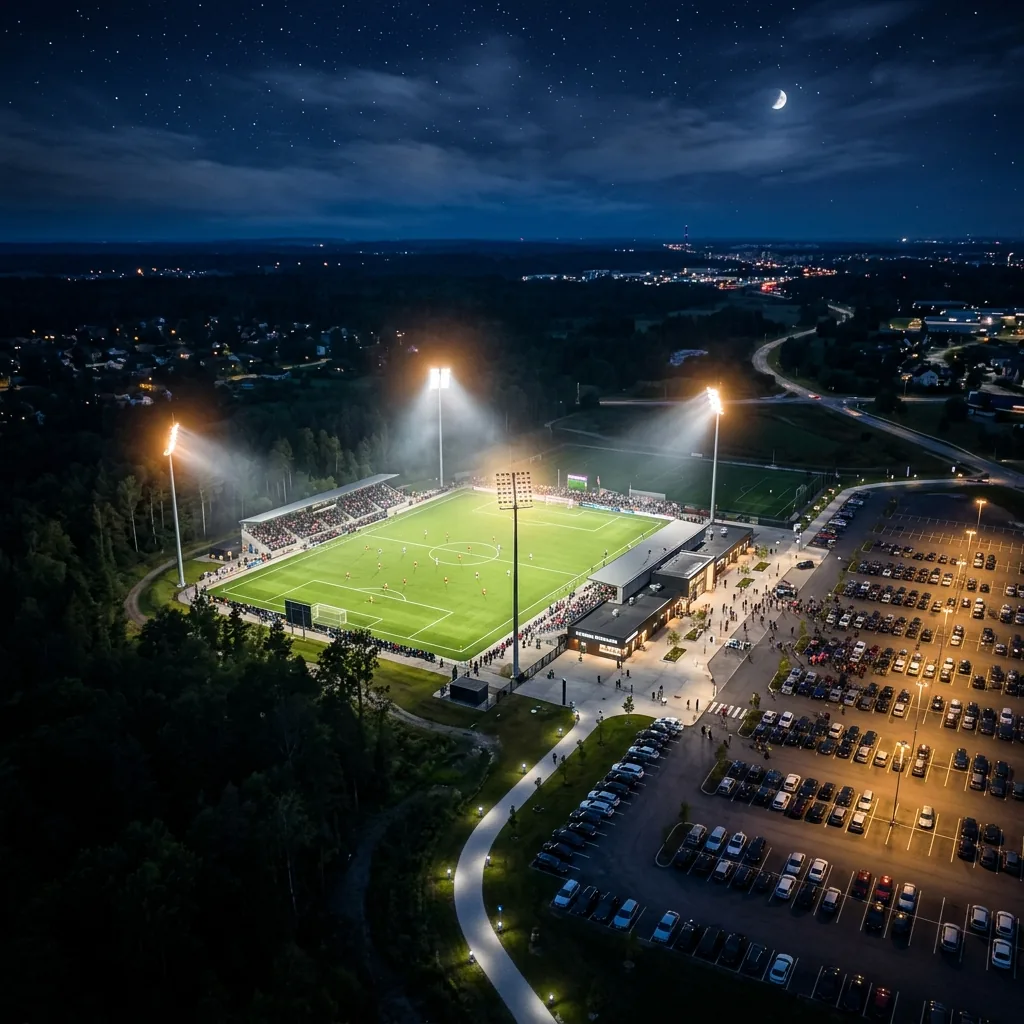
Use Type V distribution for interior poles and Type III for perimeter poles. Mount at 25-30 ft for commercial lots. LED with 4000K CCT provides optimal visibility without excessive blue-light trespass.
Sports Fields
Pole heights of 60-80 ft for soccer/football, 30-40 ft for tennis. Use narrow-beam LED floods aimed precisely to minimize spill. Specify flicker-free drivers for broadcast-capable venues. Always perform vertical illuminance calculations for camera positions.
Street & Highway
Use Type II or III distribution with 3000K CCT (AMA/IDA recommendation for reduced ecological impact). Cobra-head or shoebox fixtures mounted at 30-40 ft. Luminance method (cd/m²) preferred over illuminance for straight road segments.
Parks & Pathways
Decorative post-top fixtures at 12-15 ft mounting height, or bollard lighting at 3 ft for intimate pathways. Use 3000K warm white to minimize ecological impact on wildlife. Specify B0-U0-G1 BUG ratings to protect dark sky and residential neighbors.
Need a Photometric Study?
Describe the site, lighting objectives and available information so ETEM can help define the appropriate photometric and site-lighting study scope.
Frequently Asked Questions
What are minimum lighting levels for parking lots?
What is dark-sky compliant lighting?
How do you calculate pole spacing for area lighting?
Need Outdoor Lighting Engineering?
ETEM Engineering designs complete outdoor lighting systems - from parking lots and parks to sports fields and highway illumination. We deliver IES-compliant photometric studies, pole schedules, and CEC-compliant electrical drawings.
Get a Free Consultation