Automatic Transfer Switch (ATS) Design: Transition Modes, Sizing & the Mistakes That Leave Buildings in the Dark
A $500,000 generator is worthless if the transfer switch doesn't work. The ATS is the single most critical link in any emergency power system - it decides when, how fast, and how cleanly load moves between utility and backup power. Get the transition mode wrong, and you'll either trip breakers, crash servers, or violate utility interconnection rules. Here's everything you need to know.
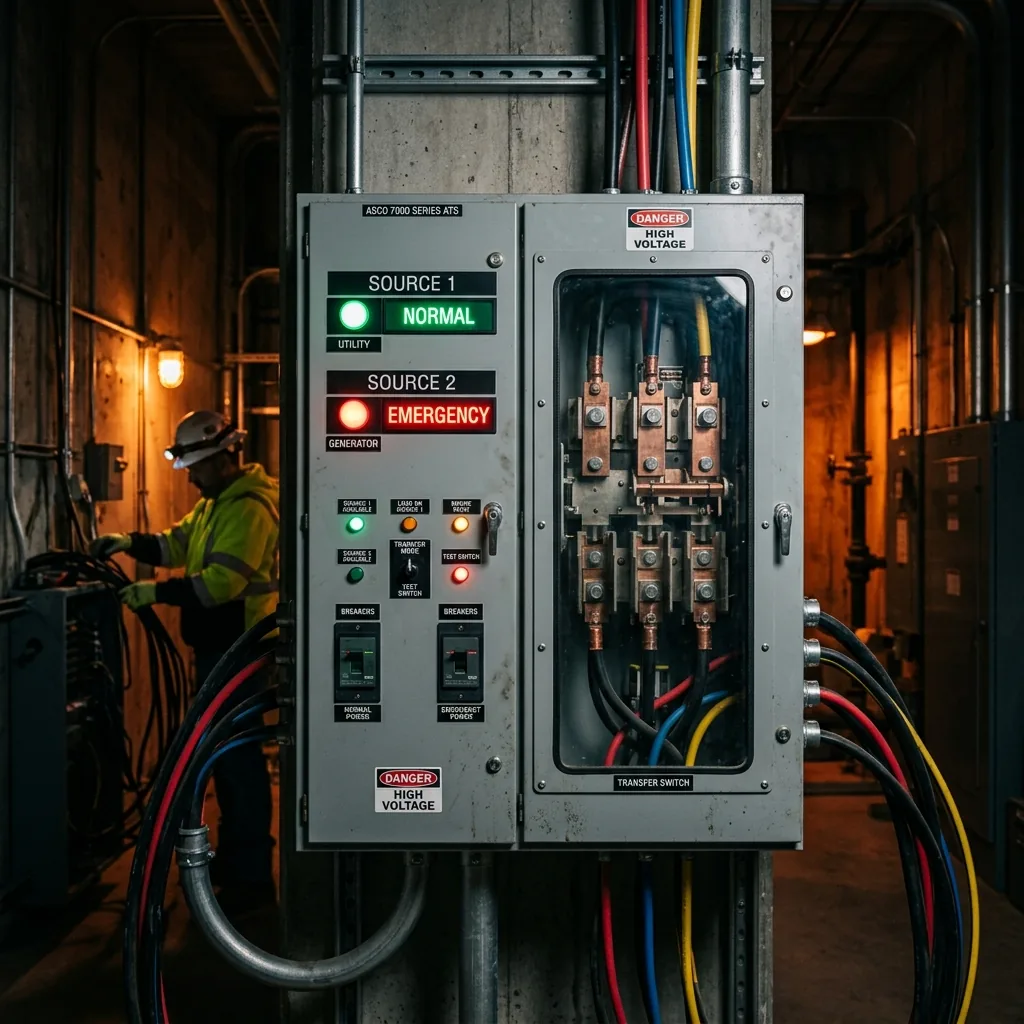
What is an Automatic Transfer Switch?
An Automatic Transfer Switch (ATS) is an electrically operated switching device that automatically transfers load between a Normal (utility) source and an Emergency (generator) source when it detects a power failure. It monitors both sources continuously and executes the transfer sequence without human intervention.
The ATS performs four critical functions:
- Sensing - monitors voltage on both Normal and Emergency sources
- Signaling - sends start signal to the generator upon utility failure
- Transferring - switches load from one source to another
- Retransferring - returns load to Normal once utility is restored and stable
The 4 Transition Modes Explained
The transition mode defines how load is transferred between sources. Choosing the wrong mode is the most common - and most expensive - ATS design error.
1. Open Transition (Break-Before-Make)
The simplest and most common mode. The ATS disconnects from the current source before connecting to the alternate source. There is a momentary interruption - typically 60-100 milliseconds.
| Parameter | Value |
|---|---|
| Transfer time | 60-100 ms |
| Power interruption | Yes |
| Sources paralleled | No |
| Best for | General commercial, HVAC, lighting |
| Utility coordination | Not required |
Use when: Load equipment can tolerate a brief outage (motors, heaters, general lighting, most HVAC systems).
2. Delayed Transition
Similar to open transition, but with a programmed delay between disconnecting from one source and connecting to another. The delay allows residual voltage on motor loads to decay before re-energizing - preventing damaging out-of-phase reconnection.
| Parameter | Value |
|---|---|
| Transfer time | 1-30 seconds (adjustable) |
| Power interruption | Yes (intentionally longer) |
| Sources paralleled | No |
| Best for | Large motor loads, transformers |
| Utility coordination | Not required |
Use when: Downstream loads include large motors or transformers that could create dangerous inrush currents if reconnected before residual voltage decays.
3. Closed Transition (Make-Before-Break)
Both sources are momentarily paralleled - the ATS connects to the new source before disconnecting from the original. The entire parallel window is less than 100 milliseconds. This provides a seamless, zero-interruption transfer.
| Parameter | Value |
|---|---|
| Transfer time | < 100 ms (parallel window) |
| Power interruption | No |
| Sources paralleled | Yes (momentarily) |
| Best for | Hospitals, data centers, critical digital equipment |
| Utility coordination | Required |
"A closed transition ATS ensures that loads are switched without interrupting power - provided at least one source is operational. But it requires utility coordination because you're momentarily paralleling two live sources."
Critical requirements for closed transition:
- In-phase monitoring - both sources must be synchronized before paralleling
- Utility approval - the local distribution company must permit source paralleling
- Fault withstand rating - ATS must handle fault currents from both sources simultaneously
4. Soft Load Transition
Like closed transition, both sources are paralleled - but for a user-selectable extended period. During this window, the ATS controller gradually increases generator output while reducing utility demand, creating a smooth, transient-free load transfer.
| Parameter | Value |
|---|---|
| Transfer time | User-selectable (minutes) |
| Power interruption | No |
| Sources paralleled | Yes (extended) |
| Best for | Peak shaving, planned maintenance, utility demand response |
| Utility coordination | Required (more stringent) |
Advanced applications: Soft load ATSs can import/export power, perform peak-shaving to reduce utility costs, and maintain parallel operation of both sources for maximum reliability.
Transition Mode Selection Guide
| Application | Recommended Mode | Reason |
|---|---|---|
| General commercial / retail | Open Transition | Cost-effective, simple, no utility coordination |
| Large motor loads (chillers, pumps) | Delayed Transition | Prevents out-of-phase reconnection damage |
| Hospitals / healthcare | Closed Transition | CEC 24-302 + CSA Z32 require zero-interruption |
| Data centers (Tier III+) | Closed Transition | Digital equipment sensitive to > 8ms interruption |
| Peak shaving / demand response | Soft Load | Gradual load migration, utility cost reduction |
| High-rise residential | Open Transition | Elevator pre-transfer, fire pump standard |
CEC Section 46: Emergency Power Requirements
The Canadian Electrical Code Section 46 governs emergency power systems, and the ATS is at the heart of compliance:
- CEC 46-206 - emergency power supplies are controlled by automatic transfer equipment that actuates upon normal supply failure
- CEC 46-108 - life-safety conductors require approved emergency wiring methods and separation from non-emergency wiring except where permitted
- CEC 46-208 - emergency supply overcurrent protection must be coordinated with life-safety feeders and branch circuits
- CEC 46-202 - emergency power may be supplied by rechargeable batteries or a generator; capacity and duration are tied to building-code requirements
- OBC/NBC + CSA C282 - life-safety transfer timing, generator start performance, fuel supply, and testing must be confirmed for the specific building classification
ATS Sizing: Getting the Ratings Right
An ATS must be rated for three critical parameters:
| Rating | What It Means | How to Determine |
|---|---|---|
| Continuous current | Max sustained load current | Must equal or exceed the overcurrent device it's connected to (e.g., 400A ATS for 400A main breaker) |
| Voltage rating | System voltage class | Match system: 120/208V, 347/600V, etc. |
| Withstand & closing rating (WCR) | Max fault current the ATS can close into and withstand | Must exceed the Available Short Circuit Current (ASCC) at the ATS location |
Common sizing mistake: Specifying an ATS based only on load current without verifying the withstand rating. A 400A ATS with a 10 kAIC withstand rating installed where the ASCC is 22 kA will fail catastrophically during a fault.
The 7 Most Common ATS Design Mistakes
- Wrong transition mode - using open transition for data center loads (causes server crashes)
- Inadequate withstand rating - ATS WCR lower than available fault current
- No step loading sequence - connecting all loads through a single ATS simultaneously, overloading the generator on startup
- Missing retransfer delay - snapping back to utility the instant it returns, causing double-transfer if utility is unstable
- Ignoring utility coordination - specifying closed transition without local distribution company approval
- No exerciser/test mode - ATS sits idle for years, then fails during an actual outage because contacts have corroded
- Single ATS for mixed loads - life-safety and optional standby loads must be coordinated carefully so Section 46 wiring, transfer, and overcurrent requirements are not compromised
Frequently Asked Questions
What are the 4 ATS transition modes?
Open, delayed, closed, and soft load. Selection depends on load sensitivity. See our generator sizing guide.
How do you size an ATS?
Rate for continuous current (100%, no derate), withstand/closing rating for fault current, and transition mode. See our coordination study guide.
What does CEC Section 46 require?
Section 46 covers emergency power supplies, automatic transfer control, emergency wiring methods, and overcurrent coordination. Transfer timing and generator performance must also be checked against OBC/NBC and CSA C282.
Need an ATS Sizing Calculation?
Describe the generator, connected loads and project stage so ETEM can review the ATS transition mode, withstand rating and coordination questions relevant to the project.
Need Emergency Power System Design?
ETEM Engineering designs complete emergency power systems - generator sizing, ATS selection, step loading sequences, and CEC Section 46 compliance. From hospitals to high-rises, we deliver designs that work when it matters most.
Get a Free Consultation